Costadilà
A family’s creation with a life of its own


Quick Facts
- Location: San Lorenzo, in the hills of Vittorio Veneto
- Owner & Winemaker: Arno Cattel
- Vineyard area: ~7 hectares
- Soil type: Clay and marl at lower altitudes; limestone at higher altitudes
- Main varieties: Range from common Prosecco grapes to rare native varieties; Glera alongside Verdiso, Bianchetta Trevigiana, Perera, Boschera
- Age of vines: 30-100+ years (average 60-70 years)
- Vineyard management: Practicing Organic with Biodynamic principles
- Winemaking Philosophy: Low-intervention winemaking
Fun Facts
- “Costadilà” means “the hillside over there,” named in homage to the agricultural traditions of Vittoria Veneto and neighboring Tarzo which Ernesto Cattel sought to revive.
- The Costadilà logo depicts a rock carving that was found near the winery. Resembling similar symbols from early cave drawings around the world, the “labyrinth” might be seen as a sign of universal experience — an apt image for the organic and evolving spirit of Costadilà.
- While stepping up to lead the project his father founded, Ernesto’s son Arno has found the time to delve into discovering more rare ancestral grape varieties, “to keep the local grapes alive.” More research on the way, he says!
- Ernesto was known to keep a mixed garden by his house where he practiced closed-loop, regenerative farming; Arno now cultivates his own tomatoes, zucchinis, pumpkins and anything else that’s in season. He gets creative with his harvests, pickling and fermenting at home.
“The Creature of Costadilà”
When Ernesto Cattel founded Costadilà in 2005, he was well aware that he’d created more than a winery. In a way, the project is just one part of a whole: the physical artifact of an expansive school of thought that guided Ernesto’s outlook on life. Articoltura, a term he coined, is a concept that draws at the same time from art, culture, and agriculture; in this world the winemaker is an “articulator,” their work centered on respect for the natural ecosystem. Here creative free will meets cultural stewardship, championing native grapes and ancient techniques.
The culmination of Ernesto’s philosophy was a range of col fondo wines: refermented-in-bottle on native yeasts, always unfiltered and undisgorged. Adamant that natural life should thrive unbridled, he farmed without synthetic chemicals, pesticides or herbicides, letting weeds grow and livestock wander in peace among the vines. He bottled in clear glass to celebrate the variance in color between vintages and even between bottles of the same cuvée. In the Tarzo hills of Veneto, then throughout Italy and the world, Ernesto became known as the first to repopularize the centuries-old tradition of lees-y frizzantes.
“I grew up inside this creature,” says Arno, Ernesto’s son; like his father, he often speaks of the winery as an animate being. With Ernesto’s passing in 2018, Costadilà was taken under the communal wing of several close family friends who wanted to see its legacy continue. A few years later, Arno had the opportunity to step up to the role of lead winemaker: a transition that marked an enormous life shift, yet felt as natural as coming home to care for a loved one. “I watched Costadilà form from nothing. So it’s not that I’m taking over, or starting something new; my father created everything, from the logo to the philosophy, making a real wine like it used to be done by our ancestors. I’m just feeding the beast.”
For Arno, the return to Costadilà means more than inherited responsibility; it offers a sense of closeness with the person who built it. It wasn’t a given that Arno would one day take on his father’s project — “guard” it, as he’d say. He had carved his own way into the culinary world where he still maintains a practice on the side, incorporating regenerative gardening and at-home fermentation into artful dining experiences. “But since my father passed away,” he shares with us, “I started to think more and more: how can I help to keep his ideas and his heritage alive? There’s this beautiful connection he left me, showing me the love that he put into his project.”
When Ernesto set out to find vines in the early 2000s, most of what he adopted were old and abandoned parcels. “They were random farmers’ vineyards,” recalls Arno, “for personal production. Sometimes I was with my father while he drove around asking, ‘whose vineyard is this?’.” The vines range from 30 to 100 years old, with an average age of 65. But more exciting to Arno are the grapes themselves: a “puzzle of varieties” that resembles nothing of the neatly-planted, monovarietal rows of neighboring Prosecco productions. In Costadilà’s plots, Glera grows alongside Verdiso, Boschera, Bianchetta Trevigiana, Perera and Moscato — challenging grapes with lower yields, but integral to the local story. Soil types vary as widely as the altitudes that are notated on each bottle, with the calcareous soil of 330 SLM (sul livello del mare, or above sea level) producing flinty, citric Glera while the plot closest to the house, a former wetland, grows super-juicy Verduzzo. At all altitudes, the fruit benefits from heavy rains, cool coastal air, and sloped terrain exposed to the Venetian sun.
The changes coming from the new Costadilà team aren’t many — as few as possible, Arno says, and they’re happening slowly. Farming is done organically with biodynamic principles, like pruning by the lunar calendar. Arno has added one wine to the lineup, a non-sparkling version of the 330 that he and his father once talked about making. Besides that, he’ll stick to their three single-vineyard “altitude” cuvées, one red wine, and two blends, Ox (280 with Pinot Nero) and Moz (280 with Moscato). He’s also introduced production cycling to improve the wellbeing of the older vineyards, alternating between rest years and harvest years. Surrounded by friends in the cellar, fields, and office, Arno describes his team as exceptionally balanced: “hand and mind, mind and hand.” He knows when to seek advice from the oenologists in his circle, though his own life experience has also proven helpful. Just like in the kitchen, he says, winemaking is a series of well-timed decisions: a harmonious pairing of science and intuition.
280slm 
“A rediscovered wine, old gold in color. Just like our forefathers, we’ve combined white and red grapes — with zero sulfur added.”
Grapes: Glera, Bianchetta Trevigiana, Verdiso, Perera, Boschera
Vineyard: 50-year-old vines (planted in the 1970s) in Campea di Miane; clay marl soil.
Making of: Grapes undergo spontaneous fermentation and macerate on skins for 30 days in stainless steel before aging for 3 months in wood barrels. Decanted into steel before bottling unfiltered, no sulfur added, with the addition of must from dried grapes for a re-fermentation in bottle.
Personality (winemaker’s notes): Golden yellow with fragrant aromas of fresh yeast and clear hints of tropical fruit and florals. Juicy palate with soft, fresh tones and a pleasant mineral flavor, leading into a long persistent finish. Pair with Venetian cicchetti: crouton with creamed cod, boiled octopus, half an egg with anchovies, sardines in onion sauce!
450slm
“A zesty wine typical of young vineyards.”
Grapes: Glera, Bianchetta Trevigiana, Verdiso
Vineyard: 70-year-old vines (planted in the 1950s) in the hills around Combai; chalky soil.
Making of: Grapes undergo spontaneous fermentation and macerate on skins for a short 10 days in stainless steel, then age in the same vessels. Bottled unfiltered, with the addition of fresh must of dried Glera and Bianchetta Trevigiana from the same vintage for a re-fermentation in bottle
Personality (winemaker’s notes): Intense straw-yellow with golden reflections, fruity and floral hints of wildflowers, hawthorn, and acacia; scents of medicinal herbs and a light spicy touch reminiscent of green cardamom and ginger. The freshness and flavor, well-balanced, are accompanied by a fine bubble and a delicate astringent finish. A satisfying sparkling wine that’s tasty and versatile; try pairing with exotic cuisine such as chicken and vegetable tagine.
330slm
“An unclarified, golden yellow wine on indigenous yeasts.”
Grape: Glera
Vineyard: 15-year-old vines on the hills of Vittorio Veneto; clay soil mixed with pebbles from the glacier-carved Moraine Hills.
Making of: Grapes are direct pressed and spontaneously ferment in steel tanks. Bottled unfiltered with additional lees from the same vintage (fondo) for a re-fermentation in bottle.
Personality (winemaker’s notes): Pale straw color with greenish reflections. On the nose, florals and fresh fruit accompany a balsamic finish and mineral verve. The sip is fresh and dynamic, finishing with a delicate note of almond. A lean, immediate wine that invites conviviality, perfect as an aperitif or to accompany a first course of fish from the Venetian Lagoon.
330slm Still 
Originally dreamed up by Ernesto, this fermo version of 330 is the new wine that Arno has added to the Costadilà portfolio after becoming the head winemaker.
Grape: Glera
Vineyard: 15-year-old vines on the hills of Vittorio Veneto; clay soil mixed with pebbles from the glacier-carved Moraine Hills.
Making of: Grapes undergo a short skin maceration and spontaneously ferment in steel tanks.
Personality (winemaker’s notes): Fresh and lively, with a pleasant acidity. The short maceration lends a light structure and natural softness to the purity and freshness of Glera. The finish is savory and persistent, with a mineral note that reflects the wine’s terroir — notes of delicate white flowers, chamomile, pear, yellow apple, peach, and subtle citrus.
MÓZ
“Moscato with no frills.”
Grapes: Moscato Fior d’Arancio & Glera
Vineyard: 30-year-old vines in Villa dei Vescovi di Torreglia, in the Euganei Hills. Volcanic soil.
Making of: Grapes are direct pressed and spontaneously ferment in steel tanks, where they macerate on skins for 15 days (for the Glera) to 30 days (for the Moscato). Bottled unfiltered, with added dried grape must for a re-fermentation in bottle.
Personality (winemaker’s notes): Captivating nose with pleasant aromas rich in fruity nuances. On the palate, a dry, fresh and fragrant sip, with a fine salty-mineral finish. Nicely balanced with a light bitter note that accompanies the finish. Pair with fish and shellfish as a surprising twist on a classic frizzante.
O-X
“A sparkling rosé with white grapes from the hills and red from the mountain.”
Grapes: Glera & Pinot Nero
Vineyard: 15-year-old vines around Belluno; sedimentary soil with marl
Making of: Glera is direct-pressed and Pinot Noir undergoes a very short skin maceration; the juice spontaneously ferments before aging for 3-4 months in steel. Bottled unfiltered, with added dried grape must for a re-fermentation in bottle.
Personality (winemaker’s notes): A meeting of the noble grape Pinot Noir and the aromatic expression of Glera, with its subtle floral and fruity aromas. A sparkling wine with elegant texture and fresh acidity, tasty with a taut, fine palate. Pair with prosciutto or a razor clam risotto.
Rosso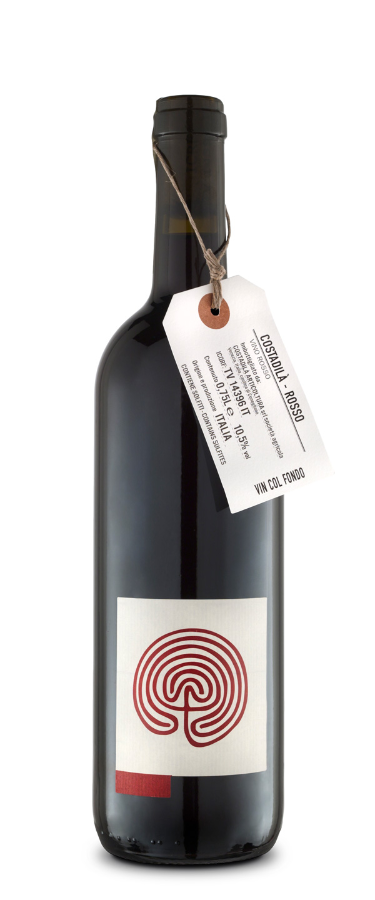
“An honest red wine without alchemy.”
Grapes: Merlot & Cabernet
Vineyard: 30-year-old vines around Salgareda; sedimentary soil
Making of: Grapes are harvested partially at peak ripeness and partially over-ripe; spontaneous fermentation occurs before a one month maceration in steel tanks. Bottled unfined, unfiltered, with no added SO2.
Personality (winemaker’s notes): A lively ruby red, the nose opens with varietal hints of fresh red fruit: cherry, raspberry, blackcurrant and blackberry. Vegetal, spicy and undergrowth accents complete the aromatic traits, while on the palate it is fresh, juicy and satisfying with lively tannins. Pure and exuberant, of good drinkability, it goes well with the classic country snack of bread and salami or in combination with a plate of ‘white’ ragù and tagliatelle.